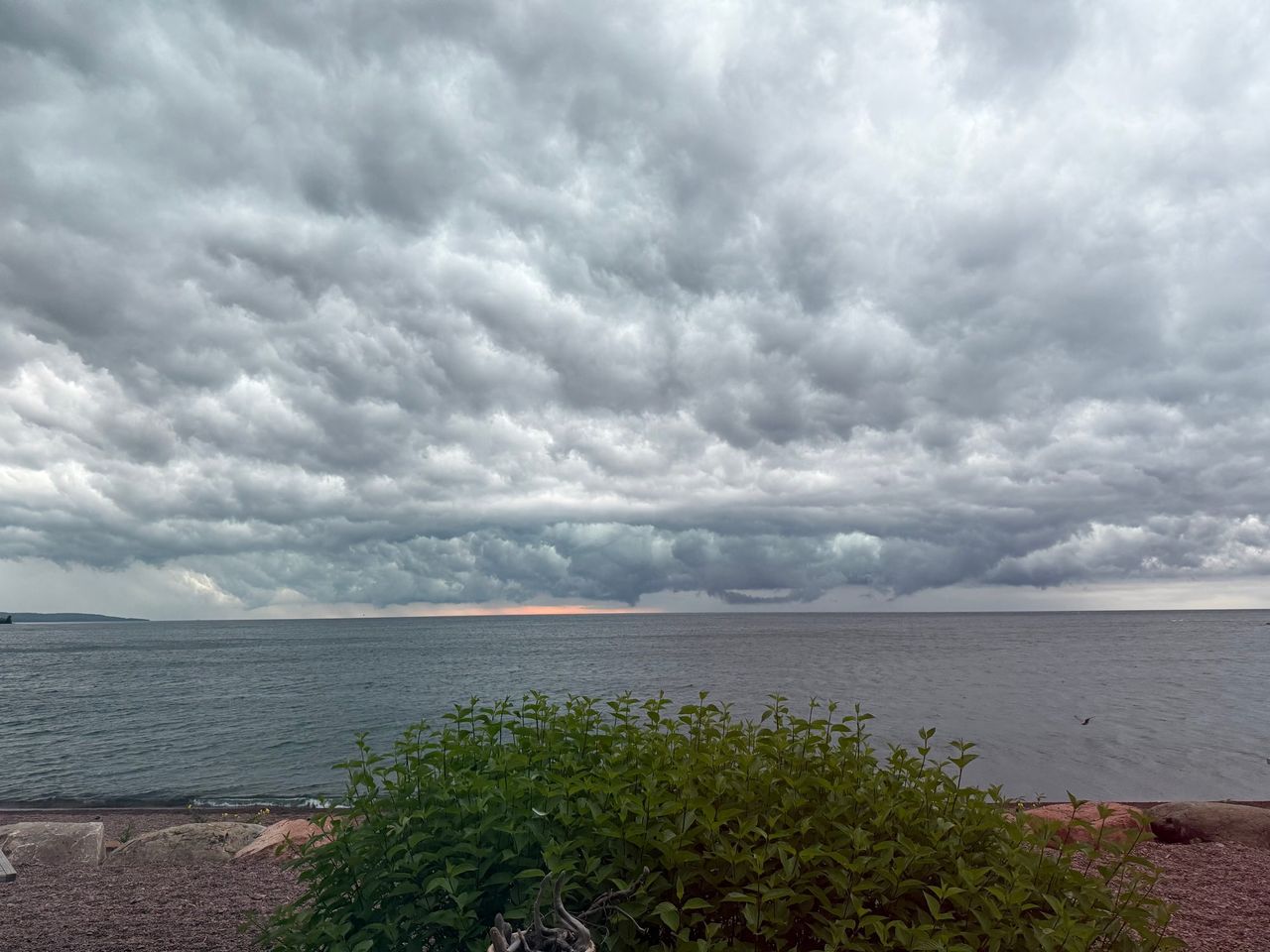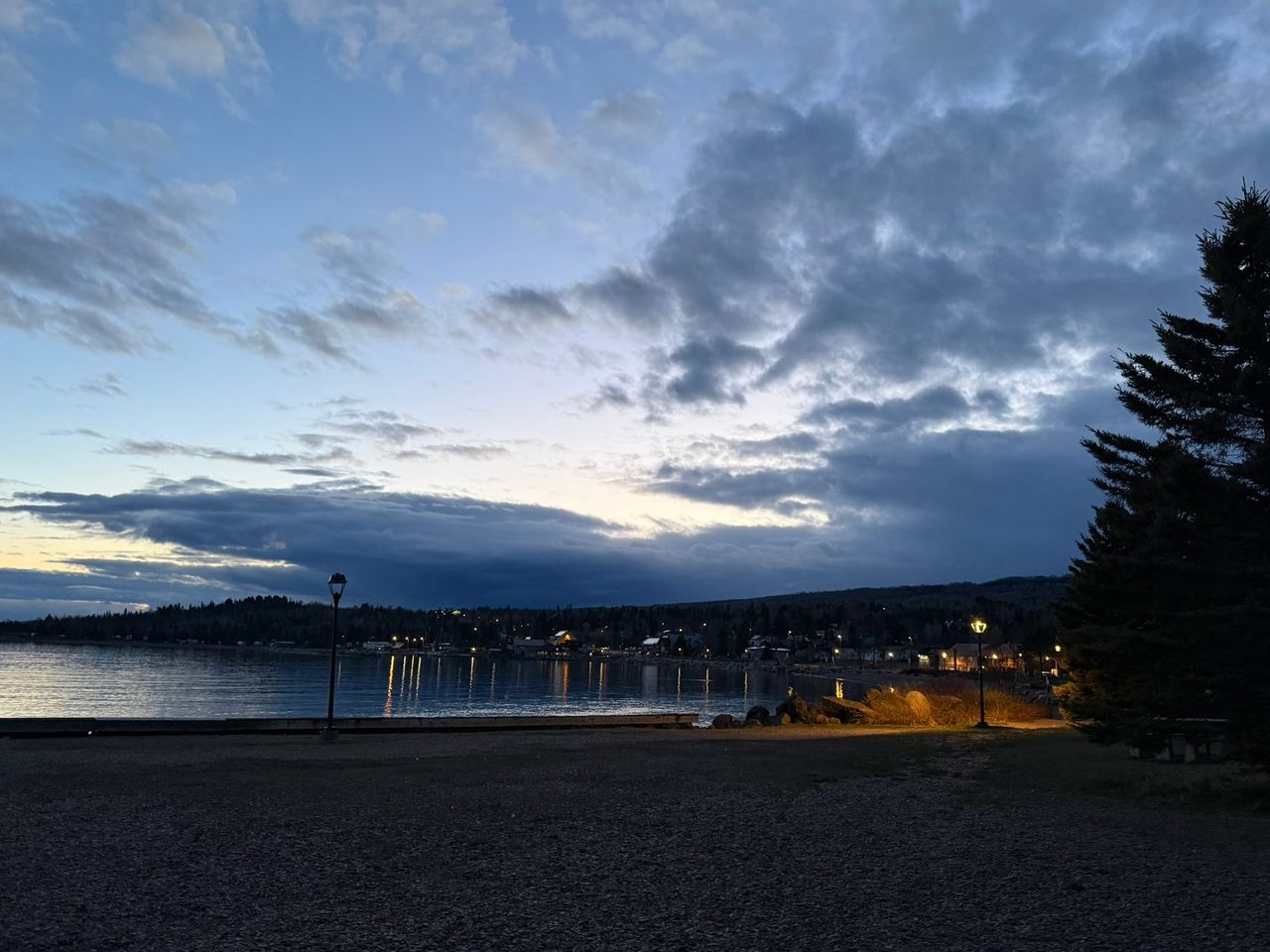
Grand Marais exists because of its harbor. Two bays with a rock point between them gave boats shelter on a coast that has very little. This guide gives the dates the record supports and says where sources disagree.
Gichi-Biitoobiig
The Ojibwe name for this place is Gichi-Biitoobiig. Erik Martin Redix, writing as Ojibwe Language Coordinator for the Grand Portage Band of Lake Superior Chippewa, explains that the word describes the two nearly identical bays with a very narrow strip of land between them. He notes that you can see it as you come down the Gunflint Trail into town.
Older books spell it differently. A 1920 state reference printed "Kitchi-bitobig" and translated it as the great duplicate water, and historian Timothy Cochrane writes Gichi Bitobig. This guide uses the spelling from the Band's language coordinator.
Ojibwe people were living in this region by the mid-1700s, and Indigenous people had been here for thousands of years before that. The Grand Portage Band's leaders signed the 1854 Treaty of LaPointe, which ceded most of their homeland, including the land Grand Marais stands on, to the United States. The Band is still here, up the shore. Read the Grand Portage guide alongside this one.
The French name and the fur trade
Grand Marais is French for "great marsh." According to Warren Upham's Minnesota Geographic Names (1920), the name goes back to early fur-trading times and referred to a marsh of twenty acres or less at the head of the harbor, nearly level with the lake.
The big fur trade depot on this shore was at Grand Portage, not here. But Grand Marais had its own small post. In 1823 the American Fur Company sent a clerk, Bela Chapman, to set up a post at Gichi Bitobig and compete with the Hudson's Bay Company. George Johnston followed him. Chapman's journal, published by the University of Minnesota Press with Cochrane's commentary, shows the local Anishinaabeg playing the American newcomers against their British rivals.
Settlement, 1854 to the 1880s
A historical marker at the harbor dates the first white settlement on the bay to 1854, the treaty year, when a few Ojibwe families were living in tepees and cabins around the shore. The marker says the white population grew quickly only after the 1870s.
Cook County was established on March 9, 1874. In 1875 Henry Mayhew, a trader and prospector, hired a crew of Ojibwe men to cut a wagon road from Grand Marais toward his second post on Rove Lake. That rough track was the beginning of the Gunflint Trail.
Close by, an Ojibwe village known as Chippewa City (Nishkwakwansing) grew to more than 100 families in the 1880s and 1890s. The artist George Morrison was born and raised there. Its church, St. Francis Xavier, still stands.
Building the harbor
With no road, everything came and went by boat, and storms made that dangerous. Congress authorized the Grand Marais harbor project in the Rivers and Harbors Act of 1879. The Army Corps of Engineers built a breakwater out from the east point and dredged the harbor to 16 feet. Sources differ by a year on when the east breakwater was finished. The harbor marker says 1884, and the station history at Lighthousefriends says 1883. The west breakwater was completed in 1901. See the Army Corps guide for the harbor today.
The lighthouse
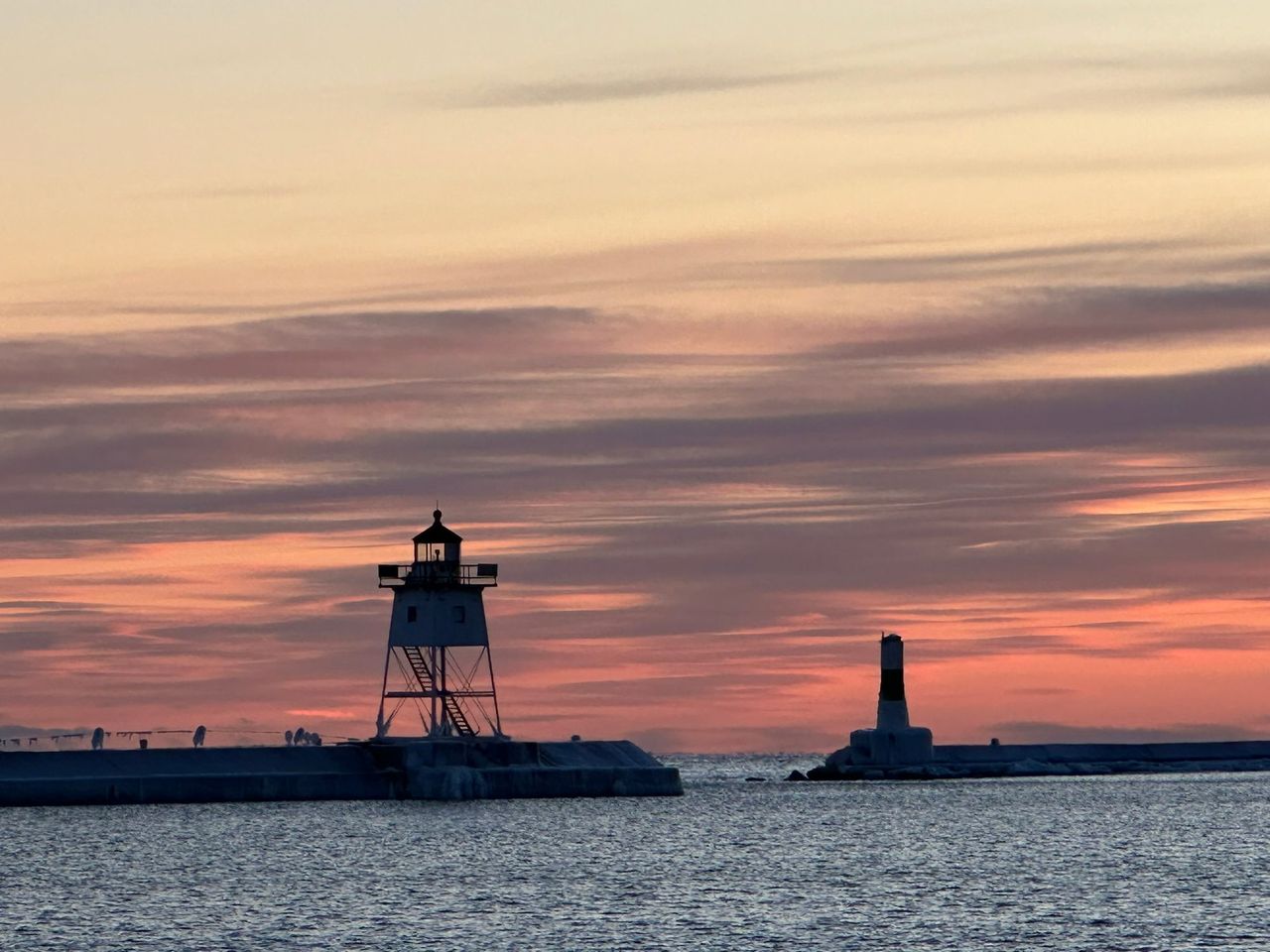
The U.S. Coast Guard Historian's Office gives 1885 as the year the light station was established. The first tower was a square, pyramidal wooden one, and the original lens was a fifth-order Fresnel. According to Lighthousefriends, its light and fog bell went into service on September 1, 1885. The Historical Society's page on the keeper's house gives 1884.
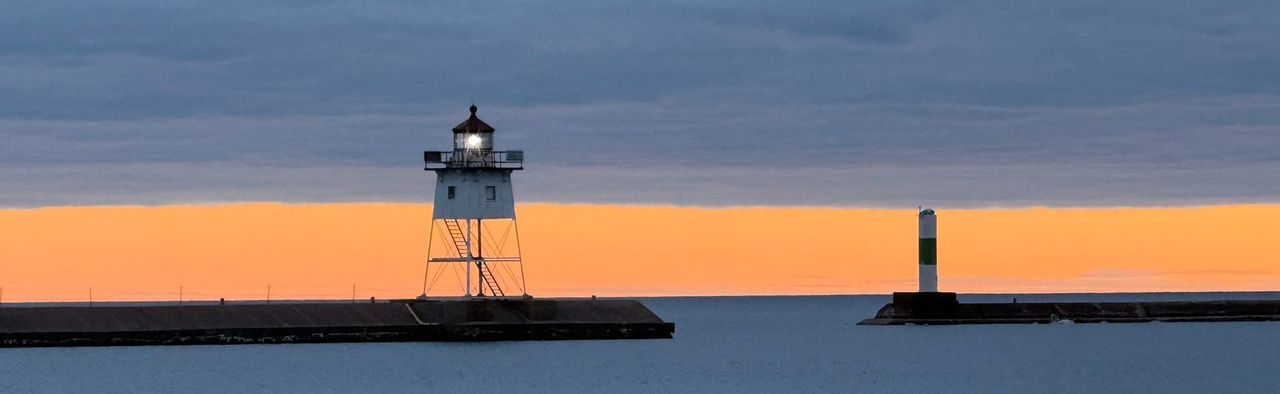
Storms battered the wooden tower, and in November 1919 a gale tore holes in two of its walls. The white steel skeleton tower you see now replaced it.
The year of the steel tower is not settled. The Coast Guard Historian's Office lists the current tower as first lit in 1922. Lighthousefriends, a detailed station history that quotes the keeper of the day, says the steel tower was already standing in 1920, was moved 60 yards east along the breakwater on November 1, 1920, and was returned to the end of the breakwater after a War Department permit in October 1922. The two accounts fit together if the tower was built in 1920 and took its present position in 1922. We found no primary document that settles it, so this guide gives the date as 1920 to 1922.
The keeper's house on shore was finished in 1896. The Cook County Historical Society acquired it in 1966, and it has been on the National Register of Historic Places since 1978. It is now the Cook County History Museum, at 8 S. Broadway Ave., and the lighthouse's Fresnel lens is on display inside. The light itself is still an active aid to navigation.
Fish and timber
By 1918 Grand Marais was considered the center of the North Shore fishing industry, with 126 licensed fishermen and a reported catch of more than 4 million pounds a year. Pulpwood, gravel and other forest products left the harbor by ship for mills across the lake.
The work killed people. In March 1919 the North Shore Fishermen's Association petitioned for a life-saving station, saying it had lost about 15 men to storms.
The Historical Society keeps the 35-foot fishing tug Nee-Gee, built here in 1935 and 1936, beside a replica 1930s fish house at the Recreation Area. The Corps notes that the harbor is still home to a commercial fishing operation.
The Coast Guard station
The white two-story building on the harbor beside Artist's Point was a working Coast Guard station for most of a century. It closed in 2022.
How it came to be built
There was no life-saving station here before it. When the fishermen petitioned in 1919, the nearest one was 90 miles across the lake in Michigan, or 120 miles down the shore by road in Duluth. Congressman W. L. Carss of Duluth introduced a bill that year and President Wilson signed it in May 1920, but the money was not available until February 1928.
Work began that August. Local contractor Ed Nunstedt built the station on a bid of $27,992. Chief Warrant Officer Daniel Magnusson arrived in January 1929 to take charge, thirteen crewmen followed in April, and the station was commissioned on May 10, 1929. It was named North Superior. A 40-foot watch tower went up on what is now called Artists' Point.
The work
In the 1930s the crew kept a lookout 24 hours a day, standing four hours on and eight off. The rescue boat was a 36-foot self-righting lifeboat. Crew families lived at the station. Bob Bero, its engineer from 1971, has described moving into the second floor with his wife and child.
MNopedia credits the station's crews with rescuing hundreds of fishermen, boat crews, passengers and recreational boaters. In 1958 a crew rescued the fisherman Helmer Aakvik, who had been adrift on the lake for 24 hours. In 1967 Engineman First Class Keith Brubaker drowned in the harbor. He is the only crew member who died while the station was in operation.
The station and the lighthouse
The light and the rescue station began under different agencies. The U.S. Lighthouse Service ran the light until July 1, 1939, when it was consolidated with the Coast Guard. After 1946 the keeper's house in town, now the history museum, was the home of the Coast Guard commander. The station stands near the walkway that leads out to the light.
Closings and reopenings
The station closed in the spring of 1973, after the Nixon administration impounded $10 million in Coast Guard appropriations. Coast Guard Auxiliary volunteers kept a limited operation going in the boating season. It reopened in 1977 as Station North Superior with a crew of seven, after Representative Oberstar worked to fund it following the sinking of the Edmund Fitzgerald. Budget cuts closed it again in 1988. From 1997 it ran from May to October with a two-man rotating crew. Its area ran from Taconite Harbor to the Canadian border and included Isle Royale.
The 2022 closure
The Coast Guard announced the closure in June 2021 and shut the station for good on Labor Day 2022, consolidating it with Station Duluth. It said the station was staffed only in summer, by four people and a boat from Duluth, and had averaged less than one call a year over the previous decade. A Coast Guard spokesman said the service would not consolidate stations if it thought that would raise the risk to boaters.
Local officials disagreed. Cook County Sheriff Pat Eliasen told a Duluth television station that Coast Guard inspections were part of why emergencies were rare, and that the shore would be less safe without the station.
Rescue on this shore now
Coast Guard emergency calls now go through Station Duluth. Closer to home, the Grand Portage Band started a marine rescue program it calls Genawaaboonagak, "keeping watch while on the water." The Band says Chairman Bobby Deschampe testified to the Minnesota Legislature about the gap the closure left, and the state provided $3 million. The money bought four rescue boats. The Band keeps two and gave one each to Cook County and Lake County. WTIP reported in June 2026 that the Cook County Sheriff's Office will operate the county's boat.
The building
The Coast Guard is returning the 1.21-acre property to the City of Grand Marais under the terms of the original deed. Contractors did the required environmental assessment in late fall 2025. As of June 2026 the Coast Guard had given no date for the transfer. Mayor Tracy Benson has said the city will ask the public what the property should become once the city owns it.
The building is not empty in the meantime. The Border Patrol began using it in 2008, and government crews still work out of it from time to time.
The station's bell is already back. On June 17, 2026, Bob Bero gave the City Council the 10-inch bell, which he had kept safe since the station closed in 1973.
The road, the village and the visitors
Grand Marais incorporated as a village in 1903. For two more decades the harbor was the front door. Steamships such as the America carried people and supplies. Then the state laid out Trunk Highway 1 along the North Shore to the Pigeon River, with work beginning in 1921. In 1934 the route became U.S. Highway 61. The harbor marker says the harbor was the focus of life in Grand Marais until the highway was built.
The road brought tourists. The first resort on the Gunflint Trail opened in 1920, and the whole trail was paved by 1979. In town, Birney Quick of the Minneapolis School of Art opened a summer outdoor painting school in 1947. It is now the Grand Marais Art Colony. North House Folk School followed in 1997. The community guide covers what both offer today.
Fires
Johnson's log trading post burned in 1926; the Johnson Heritage Post gallery was later built to resemble it. In May 2007 the Ham Lake Fire burned more than 75,000 acres in Minnesota and Ontario, destroying 61 residences by the Forest Service's count. On April 13, 2020, a wind-driven fire destroyed three downtown businesses, the Crooked Spoon Cafe, Picnic and Pine, and White Pine North. No one was hurt.
Timeline
| Year | What happened | Source |
|---|---|---|
| 1823 | American Fur Company clerk Bela Chapman sets up a post at Gichi Bitobig | University of Minnesota Press |
| 1854 | Treaty of LaPointe; first white settlement on the bay | Grand Portage Band; harbor marker |
| 1879 | Congress authorizes the harbor project | Army Corps of Engineers |
| 1883 or 1884 | East breakwater completed | Lighthousefriends; harbor marker |
| 1885 | Light station established; first light shown September 1 | Coast Guard Historian; Lighthousefriends |
| 1896 | Keeper's house completed | Cook County Historical Society |
| 1901 | West breakwater completed | Harbor marker; Lighthousefriends |
| 1903 | Grand Marais incorporated as a village | Placeography |
| 1920 to 1922 | Present steel light tower erected and placed at the breakwater end | Coast Guard Historian; Lighthousefriends |
| 1920 | Congress authorizes a Coast Guard station in Cook County | MNopedia |
| 1929 | Coast Guard station North Superior commissioned, May 10 | MNopedia |
| 1939 | Lighthouse Service consolidated with the Coast Guard, July 1 | Coast Guard Historian |
| 1947 | Summer painting school opens, now the Art Colony | Grand Marais Art Colony |
| 1973 | Station closed; Auxiliary volunteers keep a limited operation | MNopedia |
| 1977 | Reopens as Station North Superior | MNopedia |
| 2007 | Ham Lake Fire | U.S. Forest Service marker |
| 2020 | Downtown fire, April 13 | MPR News |
| 2022 | Coast Guard station closes; calls go to Station Duluth | MNopedia; WTIP |
| 2025 | Grand Portage Band launches its marine rescue program | Grand Portage Band |
| 2026 | Station bell returned to the city, June 17 | Boreal Community Media |
To go deeper, visit the Cook County History Museum. It is free.